Written by Dun Pai Fireworks Group
Recently some of our customers have been approached by their banks with “programs” supposedly designed to “protect” them from the USD to RMB Foreign Exchange (FX) Risk. With the Chinese currency in the news recently I thought it would be useful to try to investigate and explain the impact FX has on Fireworks importers. Lets discuss the historical context fist.
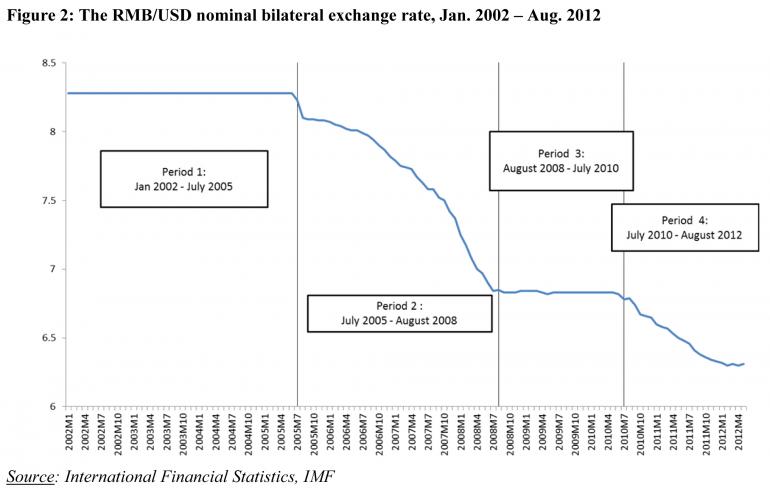 From 1960 – 1985 the rate moved between 1-2 RMB per dollar. So, this was an “expensive period for fireworks importers” but it was also before China privatized fireworks companies and thus prices were not really reflective of actual costs. From 1985 to 1993 China began the process of privatizing state owned factories. To give these factories some help, China depreciated its currency thus allowing factories to sell at a lower USD cost.
From 1993 to 2006 is what I call the golden age of fireworks, the currency was stable at about 8 RMB per USD.
This strong currency made fireworks comparatively cheap. This stimulated the export market for items like toys, fireworks, and hundreds of other simple products. China’s export factories expanded rapidly. For fireworks, originally there were only a handful of government run factories in Liuyang (maybe less then 50). By the end of the golden age in 2006 there were hundreds if not thousands.
By 2006 China was prospering. Demand for its manufactured goods had been raising for many years and factory owners had accumulated significant wealth. Inflation inside China for labor and food began to raise quickly. The government decided that it wanted to slow down the overheating export sector and try to encourage “high tech” manufacturing and domestic consumption instead. Starting in 2005 and ending in 2008 the RMB was allowed to appreciate by over 20%. (the first dip in the chart above) This effectively made fireworks more expensive. What is more is that a Tax rebate, which was given to exporters of Fireworks, was also removed in 2006. This further increased the cost of fireworks for importers.
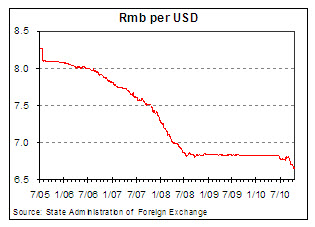 In 2008 the USA and other major economic players suffered a “financial crisis”. The Chinese seeing the potential that USA buyers might not be able to afford the higher prices reversed course in 2008 and re-instituted the Export Tax credit and stabilized the RMB appreciation. Dun Pai actually lowered prices by about 5% that year passing on these measures to our customers in an attempt to maintain our volume.
However, the real story in 2008 was not really the tax credit or the RMB. These were small potatoes compared to the stimulus program that China implemented. Just as the USA implemented government bail-outs of banks and auto companies, and printed more money in the form of QE, China also had its own form of QE. Amazingly, even though the USA has invested trillions in stimulus (printing money) since 2008. China has actually injected even more stimulus than even the USA.
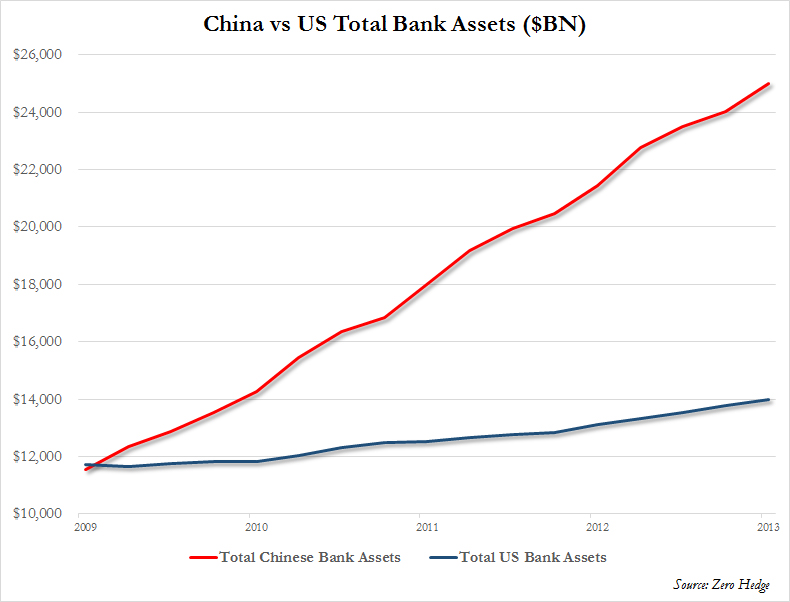
Most of the USA’s newly printed money seems to have flowed to the upper 1% and the stock market. In China, all this extra money also seems to have flowed to the “insiders”. Rather then taking that money and putting it into the stock market which is not trusted in China, the “insiders” have been building real estate. The common people of China have long been famous as savers. Somehow, even people who would seem to be meager workers can accumulate significant wealth over a lifetime. It is not uncommon for even common families in China to have saved hundreds of thousands or even a million of USD over the course of a lifetime. With low costs of food & medical, zero effective taxes, no distractions for buying junk (most products manufactured in China were not available for sale), you can start to understand how a family who only earned a small wage could still save a lot of money over time.
Part of any stimulus is to set interest rates low. This encourages bank lending but it punishes household savings. Thus, Chinese households have been looking for a place to invest their money. They are not allowed to legally invest their money outside of China. They don’t trust the Chinese stock market. Therefore, all these Chinese households began to withdraw their money from banks and have been investing in real estate. As property prices have risen, this has just fueled the buying spree as people think they better get a home now or next year they will not be able to afford one. Thus, a classic real estate bubble has been created in China. There are talk of “ghost cities” and “empty apartments”. This is true. Families will often purchase an apartment and plan to just leave it empty for their children who might move into it in 10 years time.
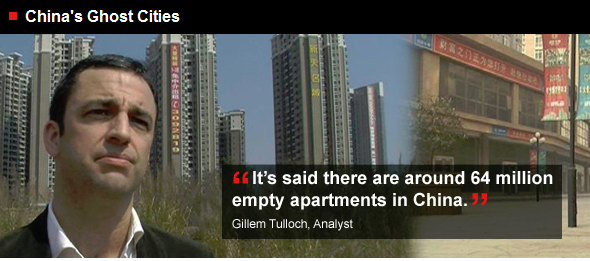
The bottom line is that the Government printed money. Then connected individuals received loans from banks to build apartment complexes and shopping centers. In the fireworks industry, many of the “fireworks factories” used this opportunity to diversify and built apartment buildings using their connections in the local government. From 2008 – 2013 this strategy seemed to be paying off well as property developers have been able to sell the apartments, and pay off the loans.
However, recently there is talk that some companies are starting to run into trouble and therefore can’t pay off their loans they took to build the real estate. How the Chinese government will handle these “defaults” is yet to be seen. They may allow these companies to go out of business. Which could mean many of the Chinese Fireworks factories who have been playing dangerously in the real estate market could also go out of business, raise prices, demand payment in advance, etc.
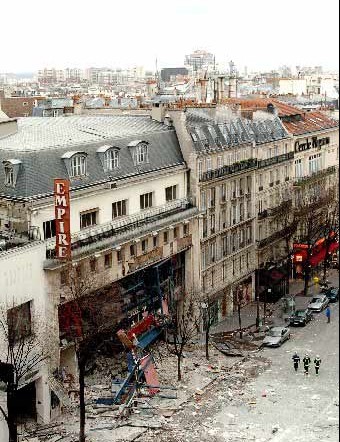
This failed hotel in Liuyang has gone through two owners since opening:
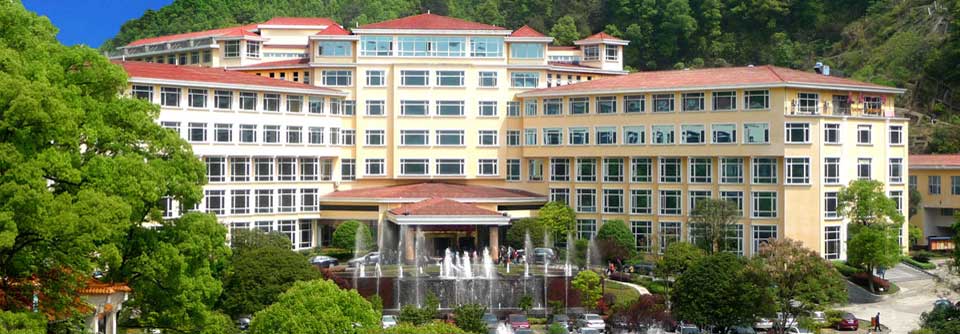
This brings us to the recent depreciation.
Most of you have probably now heard the RMB has recently reversed its decade long trend of appreciation (which increases costs for fireworks importers) and has started to depreciate (making fireworks cheaper for importers).
This also seems to make sense with the argument that China is starting to see issues with slow downs and thus is depreciating the currency to stimulate the economy.
The many news reports have headlines such as “China enters currency wars” or “China real estate bubble bursting” or “China credit defaults beginning”.
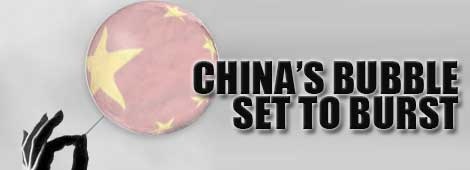 However, I caution that many of these “headlines” are probably more attention grabbers than 100% true. So far, here on the ground in China, there are no real signs of the real estate bubble bursting. There was a report of “one” credit default among thousands outstanding. So, much of the headlines at this point are just hype.
There are two possible outcomes for the next 12 months with the China currency.
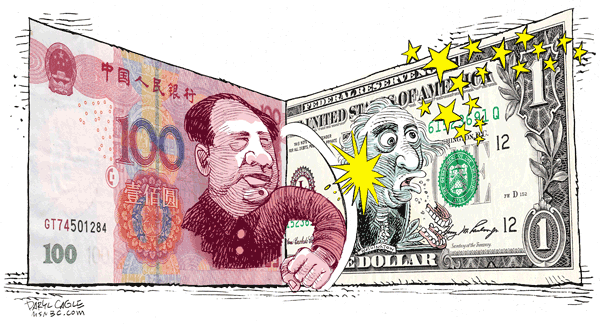 One is that China really is entering a currency war and it has depreciated the currency with the goal of boosting its export sector. This would be good news for fireworks importers in 2015, however, I caution that this is NOT the consensus of most major economists and professionals.
The consensus, and what China’s leader has stated, is that the current depreciation is just temporary and that long term the RMB will continue its decade long trend of appreciation (making fireworks more expensive in 2015). Rather than to reward China’s fireworks factories, the real reason that China has allowed depreciation this month is to try to punish currency speculators and stop the flow of “hot money” into China.
The long term appreciation of the RMB became a target for currency speculators who realized it was a no-lose bet the last several years. They utilized such exotic financial tools such as derivatives called target-redemption forwards. These make money for the buyer as long as the RMB appreciates, but if it depreciates then the buyer faces large losses. Most current TRF’s face looses at a red line of 6.2 rmb/usd. Interesting the currency has hit 6.2 and maintained this level for the past week. Thus after three years of “easy money” the buyers of these instruments are now losing money. 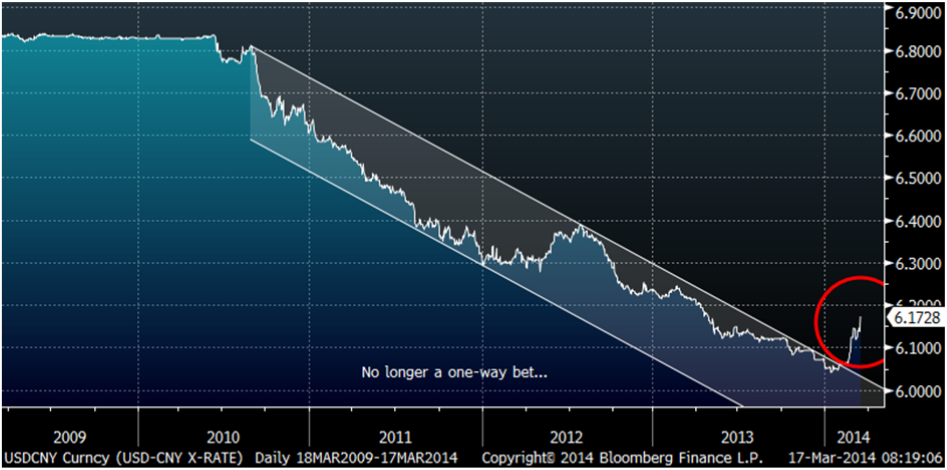
Another winning bet in the last few years has been what is referred to as the carry trade. Here investors use commodities such as copper, steel, gold, and soybeans to borrow at low interest rates, and earn money off of the RMB appreciation and interest rate spread with-out ever really intending to use or sell the underlying commodity. 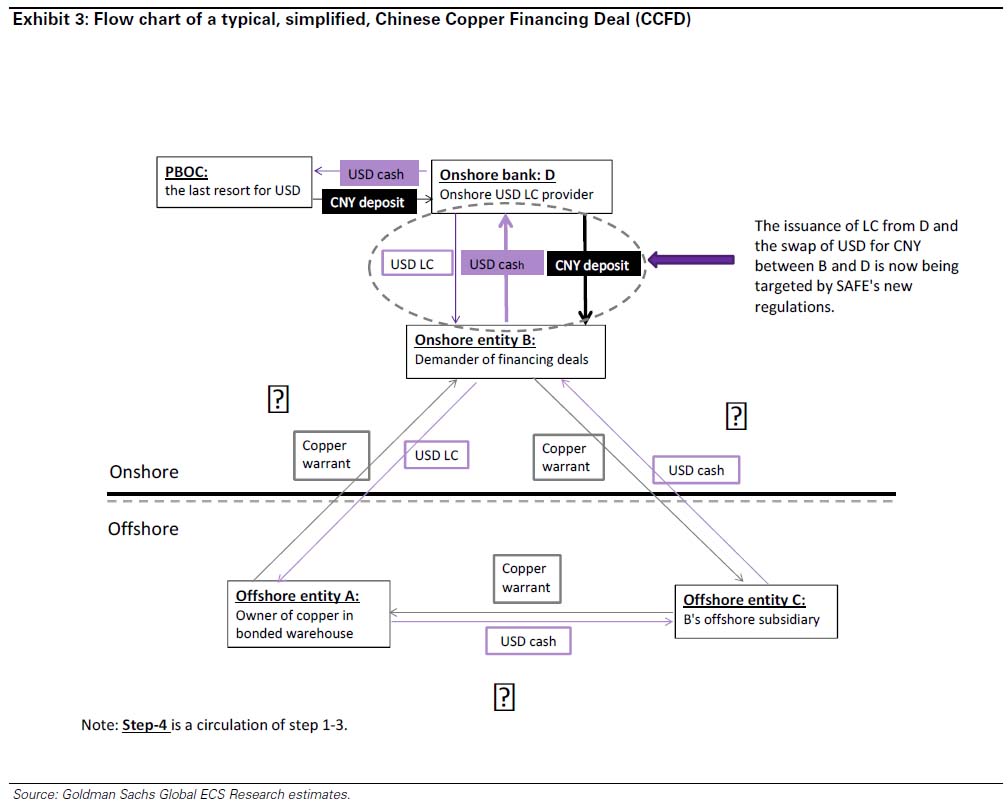
These type of financial games do not produce any real value for the economy, it makes the rich richer, it fuels inflation, and it punishes the common person.
It appears that China’s government recognizes this and to prevent households from getting angry and creating civil unrest, the government seems to have temporarily depreciated the RMB to punish the carry trade and one-way FX bets.
The coincidence of the recent depreciation and the increase of the daily trading band from 1% to 2% is not directly linked. Some assume that the change in the daily trading band is what caused the depreciation. This is not true. China’s government still fully controls the RMB exchange rate. So the daily trading band has nothing to do with the actual rate, other then a larger band means the government can change the currency even faster.
In summary, although it would be nice to think that we are going back to golden age of importing with the rmb at 8.2 to 1 usd, it is very unlikely this will happen. Significant depreciation of the RMB will cause imported energy & food prices to raise significantly and would most likely cause property prices to dramatically fall. Food and energy inflation is China’s biggest fear as that will cause wide spread anger. High property prices actually are seen as a positive for Chinese because it keeps their investment value high.
As long as China’s economy continues on at current levels with-out a major recession, then the RMB is likely to appreciate back to 6.15 or 6.0 in the coming year. If the economy is worse then it appears or is getting worse, then the RMB will stay at 6.2 or depreciate even further. The good news for the USA market is that we have the summer to see where rates are going. Dunpai usually sets its annual exchange in July of each year. We should have a much better picture by May or June.
Regarding FX, the bottom line is that your best bet is to always pay for your goods (and thus remove any FX risk) as soon as you have the cash available. Some of you may be thinking that if you postpone payment for another month or two, the RMB might depreciate further and thus you save more money. However, there is an equal chance that the RMB might return back to 6.15 next week. So, as in any gambling, right now you are “in the money”. Therefore, your best bet is that if you have the cash, make your payment right now and take advantage of the 6.15 to 6.2 RMB gain. If you wait hoping for your gain to increase, you might find that it has turned into a loss.
Regarding bank solutions called hedges. The bottom line is that a hedge is an insurance policy. Banks and Insurance companies are there to make money. They will never lose money. Therefore, typically hedges turn out to be a higher cost then if you would have just paid directly. Hedges, as insurance, are costs that are designed to address a catastrophic event in your business. With fireworks, when you have an accident, your business is effected, not the whole industry. Therefore, insurance makes sense. However, for FX, if there were a major FX change, the entire industry will be effected, in fact all industries dealing with China will be impacted. Therefore, taking out an FX insurance policy or hedge probably will not help you much if the entire USA and China economy is effected.
Bottom line:
1.) Be very careful of bank claims regarding FX. Those who bought hedges thinking they could not lose money are now losing. Most bankers probably don’t even fully understand the financial instruments they are trying to sell you.
2.) For FX, the best policy is to pay as soon as you have the money available. This eliminates your risk. Trying to time your payments to take advantage of FX can very likely backfire. You are in the money right now as our quotes were at 6.15 and we are now billing at 6.2. So if you have the cash, paying now will lock in your savings. Waiting, could potentially cause a loss if the RMB reverts to appreciation.
3.) The RMB is likely to appreciate back to 6.15 or lower by the 2015 buying season. We will know more by May or June. Keep an eye on China’s real economy (not as reported on the USA news). A significant slowdown in manufacturing or a significant sell-off in real estate will likely result in depreciation. So far, neither appear to be happening. Anything otherwise will result in a resumed long term trend of appreciation (with increased daily volatility to discourage speculation).
Written by Dun Pai Fireworks Group, http://www.dpfireworks.com