
Here is an email from Matt to our customer:
A meeting was held Saturday morning August 29th, 2020 by Liuyang/Hunan CIQ officers. This is an on-the-fly update that represents the fog of a complex situation unfolding in real-time. I do not know what will happen next. I don’t know how serious this really is or if it will be squashed by higher authorities. This situation has been building for months, and it escalated in the last week. I kept hoping it would go away, but as of the conclusion of today’s meeting, it does not appear to be going away anytime soon, so that is why I am choosing to try to update you now.
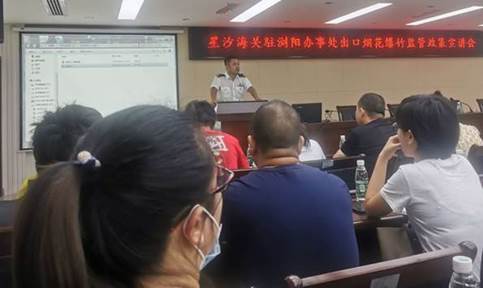
1.) The source of the problem is the USA Law for Consumer Fireworks is quite different than the fireworks laws in the rest of the world. Most of the world, including China, follows a close form of the United Nations standard for fireworks. For Consumer Fireworks, the UN standard says that cakes over 1.2 inch inside diameter are 1.3g unless tested in a UN Series 6 test and shown to be 1.4g. USA law (APA87-1) says that tube diameter is not limited, but instead limits the total powder weight, the power of the burst, and requires ½ inch space for cakes over 200g. This conflict between the USA and International laws has been in place for many decades.
2.) In the past, the China authorities have overlooked this conflict. The assumption was that Chinese made fireworks would be allowed to be built and shipped according to the exporting country’s laws. So USA products were built according to the USA law. German products were built according to the German law. Etc. The issue with this “situation” is if an accident occurs with one of these “export” products on Chinese soil. Liuyang is over 1,000 miles from the nearest port. So USA fireworks must travel long distances on Chinese soil before they can reach international waters. On December 4th, 2019 this type of accident happened. A factory making large salutes (that technically were legal in the Eastern European country they were being shipped to) had an explosion. When the federal authorities investigated the accident they used the China laws, not the laws of the Eastern European country, to determine what was legal and illegal. The federal authorities determined the factory and the local officials were breaking China law. Several people went to prison. Many workers died. Because of this Dec. 4th accident, the local officials in China have become spooked. Last month they only planned to make 3 inch cakes 1.3g. But after the Beirut Explosion they expanded it to include all cakes greater than 1.2 inch per the standard. Asking them to compromise and not include 2 inch is not likely at this point. They want to just stick to the regulation, which says all cakes greater than 1.2 inch are 1.3g by default.
3.) Specifically the recent trouble is coming from the Hunan Customs/CIQ staff. I think the main reason this group specifically has been spooked is because they are new. They recently formed in 2018 as a result of the USA/China trade War. The USA put tariffs on billions of dollars of Chinese goods. China retaliated and put tariffs on USA goods shipped to China. However, prior to the Trade War, China did not have a well-organized Customs organization to control things such as inspecting USA imports and calculating tariffs. Once this new, more powerful government agency was created and given power, they then started to expand their focus past just collecting tariffs on USA Soybeans. One area they chose to focus on was fireworks. For being such a small industry, fireworks always seems to draw an oversized interest from regulators both in USA, and now in China.
4.) The Hunan CIQ/Customs leadership holds a similar role to USA DOT, in that they issue the “classification document” to determine if a product is 1.4g or 1.3g. So similar to a USA EX number. The difference is that CIQ issues their “certification” for each batch of product produced as compared to the USA EX number which is only issued once. Some big USA importers have considered this a limited problem because right now only Hunan CIQ is pushing this. However, Hunan is producing 60-70% of the USA fireworks and if we consider the higher quality 2-3 inch cakes, it is closer to 80-90%. So the idea that we can solve this problem by moving production to Beihai is not a workable solution in my opinion.
5.) Customs/CIQ is not responsible for business. Therefore, they don’t lose anything if business is harmed. In fact, I believe they see it as their duty to try to stop businesses engaged in dangerous activity. So similar to USA where EPA, OSHA, and other government agencies drove entire industries out of the USA due to regulations that were impossible to meet, this new China agency does not seem to care if China businesses are harmed. In fact, I think they welcome it as a sign they are “being tough on safety”. They have very little to lose from being “tough”.
6.) Unfortunately the top leadership in China, also does not seem to be a supporter of the fireworks industry. They favor environmentally clean, hi-tech industry and consider fireworks a reminder of the “backwards, ancient” times. In fact, over the recent years the China Domestic market has seen a slow-down mainly due to new Federal suggestions that “Fireworks are dirty, dangerous, and backwards”. The federal government has gone so far as to try to use Fireworks and BBQ as a scapegoat for China’s massive air pollution problems. The long winded point is that I believe there are strong political pressures from above working against the fireworks industry in China. The industry as a whole is tiny compared to the China economy.
7.) Liuyang City stands to lose the most. The mayor of Liuyang has come out against these Customs/CIQ changes. But the provincial level Customs/CIQ is higher authority then the local mayor of Liuyang. So I believe that we would need to get the Federal Level Customs/CIQ leaders to intervene if we wanted to stop this from occurring. However, at this time, I am not aware of any individual company willing to attempt to talk to the federal authorities.
8.) In talking with major USA importers, the feeling as of today seems to be that this is a China problem and not a USA problem. I don’t agree because the BASE of the problem is the fact that ONLY the USA deviates from the international UN standard. Therefore, I believe that the easiest solution is for USA DOT to engage their federal level counterparts in China and work out a more legal solution to the problem created several decades ago when USA deviated from the UN Standard. I think the USA government has a responsibility to help address this deviation and not expect private companies to work out a solution alone.
9.) To help put things into perspective, we estimate that USA is only about 13% of the total China fireworks industry. This number would actually be even smaller if it were not for the recent reduction in the China domestic market. So keeping in mind that USA is only 13% of the market, it becomes easier to understand why it is NOT likely that China factories and suppliers are going to be fighting on behalf of the USA importers.
Possible Solutions:
1.) The best solution is for USA DOT and China Federal Authorities to talk and hammer out a document that allows USA goods to be manufactured, stored and shipped from the China Factory to China port, using USA law. This has been the “unofficial” approach for the last 30 years. So USA DOT and China Federal Authorities would just need to formalize what they have informally been doing for all these years. Maybe it would require some small compromises on both sides. Keep in mind this is all just paperwork. It is a simple as a 1.3g vs 1.4g mark on the carton. We suggested using both a 1.3g and 1.4g sticker on the cartons. The 1.3g sticker would note “for China shipping only”. This suggestion was rejected by Hunan CIQ, but perhaps if USA DOT raised this suggestion it would be accepted (this same issue applies to UN0431 vs UN0336).
2.) Hunan CIQ has already said that they will accept Series 6 tests as an alternative (see image below & https://www.unece.org/fileadmin/DAM/trans/danger/publi/unrec/rev21/ST-SG-AC10-1r21e_Vol1_WEB.pdf).
So that means companies would need to pay to have each item tested and “graded as 1.4g or 1.3g”. The question is who is allowed to conduct these tests. Typically USA and China have been refusing to allow each other’s labs. So China does not allow a USA lab result and USA does not allow a China lab result. So the matter of what labs would be allowed to conduct these tests needs to be cleared up. AFSL does not do Series 6 tests. It needs to be an Explosives lab. The 2nd issue is how to administer the Series 6 test. Right now Hunan Customs/CIQ is insisting that any firework debris that flies over 50 feet (including a star) is 1.3g. (a fiery projection emanating from the product is thrown more than 15 m from the edge of the packages or unpackaged articles.) Hence their suggestion to use the Iron Cage. But many USA & international testing labs interpret the “fiery projection” requirement differently and don’t count stars as projections in the Series 6 test (recent approvals of bulk 60g shells as 1.4g are examples of this different interpretation). Logically, most 1.4g cakes, even 200g cakes, have stars that fly further than 50 feet. So this means most cakes would be reclassified as 1.3g if tested. They consider a fiery projection to be a continuous jet of flame or fiery gas. So this aspect of the Series 6 test is a “debatable point” and different labs interpret “stars” differently. Currently the test is very expensive in USA (thousands of dollars). And applies product by product. So some other mass testing method would need to be devised. Maybe testing all 2 inch 500g cakes and getting a classification for all of them at once, instead of one by one.
In conclusion, the testing solution, using a Chinese Test Lab. Seems like a workable solution. The challenge will be to come up with a lower cost solution (other than an Iron Cage) that stops projections. Or changing the “interpretation” of what a projection is to not include stars as projections (as is the current interpretation by most international labs). I also believe involvement from organizations like APA, NFA and US DOT to explain why the USA law should be accepted, could also be very helpful.
We are very interested to hear your ideas and suggestions. Soon we will need to make decisions to begin to build the items for 2021 or not. We have already begun to print labels for some items. So we will need to make decisions soon.
Matt